
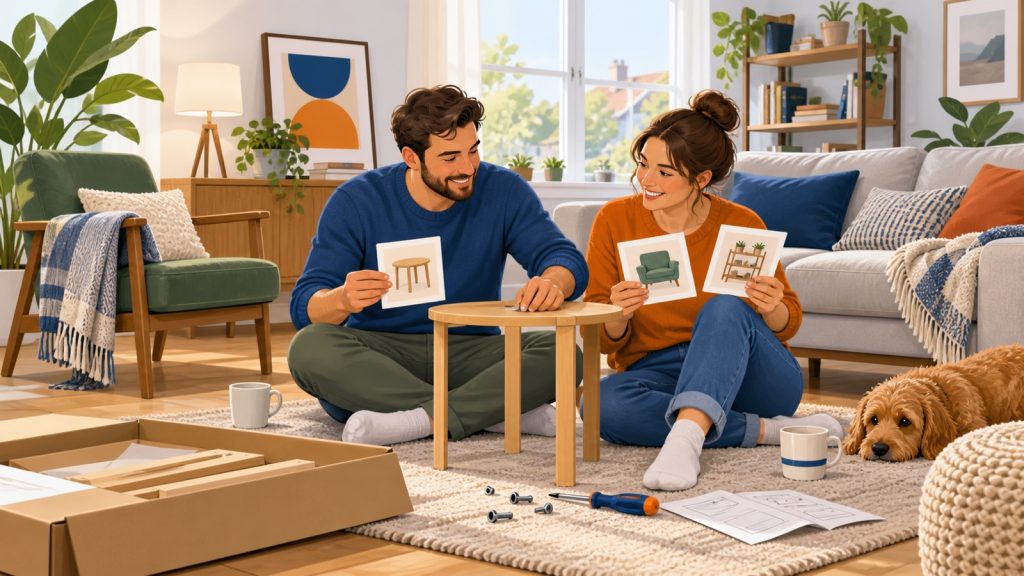
You can furnish a house on a budget by buying only the essentials first, setting a spending limit for each room and combining free, reused and carefully chosen new items. Start with somewhere safe to sleep, basic cooking equipment, lighting and essential storage; add decorative or occasional furniture later.
The cheapest item is not always the best-value item. Delivery, assembly, repairs, energy use and replacement costs can turn an apparent bargain into an expensive purchase. A written room-by-room plan helps you spend where safety and durability matter while avoiding impulse buys.
Quick answer: Measure every room and doorway, list what you already own, then divide the remaining items into “needed now”, “needed soon” and “nice to have”. Check local reuse charities, council support and trusted second-hand sellers before buying new. Inspect used furniture carefully and apply stricter safety checks to upholstered furniture, mattresses, children’s products and electrical appliances.
What furniture do you need first in a new home?
Most people need fewer items on moving day than a fully furnished show home suggests. Prioritise the things that make the property safe, functional and comfortable enough for daily life.
Your immediate list may include:
- a suitable bed frame, mattress and bedding;
- curtains or blinds where privacy or sleep would otherwise be affected;
- safe lighting and working smoke and carbon monoxide alarms where required;
- essential cooking, food-storage and washing equipment;
- a table, work surface or other practical place to eat and complete household tasks;
- enough seating for the people who live in the home; and
- basic clothes and food storage.
The exact order depends on the household. A family with a baby, a disabled person or someone working from home will have different priorities. Do not buy a standard checklist without adapting it to the property and the people using it.
How do you make a furnishing budget?
Make a furnishing budget by starting with the money genuinely available after moving costs and essential bills, then giving each priority item a maximum all-in price. Include delivery, assembly, cleaning, repairs and any accessories needed to use the item safely.
Use three lists rather than one long shopping list:
| Priority | Meaning | Examples | Buying approach |
|---|---|---|---|
| Needed now | The home is unsafe or impractical without it | Bed, essential appliance, privacy covering, basic light | Compare quickly, but do not relax safety checks |
| Needed soon | Useful within the first few weeks | Dining table, sofa, additional storage | Watch local reuse stock and seasonal sales |
| Nice to have | Improves appearance or convenience | Side tables, spare-room furniture, decorative shelving | Wait until the household budget has settled |
For every item, write down a maximum purchase price and a maximum total cost. A £40 wardrobe with a £50 delivery charge costs more than an £80 wardrobe you can collect safely. If an item needs new fixings, professional installation or a hired van, add that before deciding.
Our step-by-step household budgeting guide explains how to work out what is available without using money set aside for rent, council tax, energy, food or other priority costs.
How much does it cost to furnish a house?
There is no dependable single average cost of furnishing a house. The total depends on the number of rooms, how many people live there, what the property already includes, whether items are new or reused, and how quickly everything is purchased.
A more useful calculation is:
items required × realistic all-in cost, minus the value of usable items already owned or obtained free.
Build the estimate from the home itself:
| Cost area | What to include | Often overlooked |
|---|---|---|
| Sleeping | Frame, mattress, bedding and suitable storage | Mattress protector, delivery and old-mattress removal |
| Living area | Essential seating and lighting | Collection vehicle, cleaning and replacement covers |
| Kitchen | Necessary appliances, cookware and food storage | Connection, installation and energy use |
| Windows and floors | Privacy coverings and any essential floor covering | Poles, fixings, measuring errors and fitting |
| Children or accessibility | Age-appropriate or adapted items | Professional fitting and changing needs |
| Moving and setup | Transport, tools, assembly and disposal | Parking, stair access and bulky-waste charges |
Do not make the target “furnish every room immediately”. Set a phase-one limit for essential items, live in the property for a few weeks and then decide what would genuinely improve it. This reduces duplicate purchases and furniture that does not fit the way the room is used.
How can you furnish a house cheaply in the UK?
The cheapest practical route is usually a mixture of items you already have, free local offers, reuse charities, second-hand purchases and selected new products. No single shop or marketplace is best for every category.
Try these sources in order:
- Ask what is included. Check the tenancy, inventory or property particulars before buying an appliance, curtain rail or other item that may already be supplied.
- Use what you have differently. A small table can work as a desk temporarily, while sturdy boxes can provide short-term storage.
- Ask trusted contacts. Friends and relatives may have useful items in storage, but agree who will move them and whether they are a gift or loan.
- Search local reuse organisations. The Reuse Network has a postcode-based service finder for charities and social enterprises offering household furniture and electrical appliances.
- Check charity furniture stores. Stock changes frequently, so visiting more than once may be more productive than buying the first acceptable item elsewhere.
- Use local giveaway and selling groups carefully. Measure first, inspect before paying and never let urgency override safety.
- Compare clearance, ex-display and returned stock. Confirm the condition, warranty, delivery charge and returns terms in writing.
- Buy new where hygiene, safety or long-term use justifies it. A bargain does not have to be second-hand.
Set alerts or keep a saved list, but turn off notifications once the item is bought. Continually browsing “deals” can encourage spending on things that were never part of the plan.
Where can you find free or low-cost furniture?
Free or affordable furniture may be available through local reuse charities, community organisations, charity shops, council-linked schemes and online giveaway groups. Availability, eligibility, delivery areas and charges vary, so check locally rather than relying on a national promise.
The Reuse Network service finder can help you locate participating furniture-reuse organisations. Some charities sell to everyone at affordable prices; others reserve donated items or reduced prices for referred households. Ask whether delivery, testing, guarantees or furniture removal are included.
When using an online marketplace or community group:
- see the item in person where possible;
- check the seller’s profile and the full listing history;
- avoid advance bank transfers to an unknown private seller;
- keep communication within the platform;
- confirm measurements, condition, collection arrangements and what is included; and
- take another adult when collecting from an unfamiliar address.
Do not enter a stranger’s home or share unnecessary personal information to secure a free item. If a listing feels unsafe or changes substantially after contact, walk away.
Can your council help with furniture or appliances?
Possibly. In England, the Crisis and Resilience Fund runs from 1 April 2026 to 31 March 2029 and allows local authorities to support low-income households facing a financial shock. Government guidance specifically includes essential furniture and appliances, but each council controls its local eligibility, application process and available support.
Examples in the national guidance include beds, bedding, mattresses, tables, chairs, sofas, storage, curtains or blinds, washing machines, fridge-freezers and cookers. This does not mean every council will provide every item or that every applicant will qualify.
Use the GOV.UK local council finder and look for “local welfare assistance” or “Crisis and Resilience Fund”. If you live in Scotland, Wales or Northern Ireland, search your council and devolved-government services because arrangements differ.
Also ask housing officers, social workers, support workers, Citizens Advice or a local welfare-rights service whether a referral scheme or charitable grant is available. Apply before buying where possible: many schemes will not reimburse a purchase made in advance.
Should you buy furniture second-hand or new?
Buy second-hand when the item can be inspected properly, cleaned safely and transported for less than a suitable new alternative. Buy new when hygiene, safety, warranty, exact dimensions or expected daily use make the extra cost worthwhile.
| Option | Potential advantage | Main limitation | Best suited to |
|---|---|---|---|
| Free item | No purchase price and prevents waste | Choice, condition and transport can be unpredictable | Simple items that can be fully inspected |
| Reuse or charity shop | Items may be checked; delivery may be available | Stock changes and returns policies vary | Sofas, tables, storage and some tested appliances |
| Private second-hand seller | Wide local choice and negotiable prices | Limited protection and no assumed safety testing | Low-risk items after careful inspection |
| Ex-display or clearance | Reduced new-item price and retailer protection | Cosmetic damage, limited sizes or final stock | Durable items when terms are clear |
| New budget furniture | Known dimensions, instructions and standard rights | Assembly, delivery and shorter useful life can add cost | Mattresses, modular storage and exact-fit items |
Do not assume “vintage” means safe, durable or valuable. Older furniture may have hidden damage, missing fixings or safety standards that differ from current products.
What should you check before buying used furniture?
Before buying used furniture, check dimensions, structure, cleanliness, odour, signs of pests or damp, missing parts and how it will enter the property. Upholstered furniture should also have the required permanent fire-safety label when supplied second-hand by a business.
Take these steps:
- Measure the room, doorway, hall, lift and stairs.
- Ask for clear photographs of the front, back, underside, labels and any damage.
- Test drawers, doors, frames, legs, recliners and other moving parts.
- Look for cracks, loose joints, sharp edges, stains, mould, strong odours and signs of insects.
- Check that wall-fixing or anti-tip hardware is present where the item needs it.
- Confirm whether the item dismantles and whether instructions are available.
- Calculate collection or delivery before agreeing the price.
Government guidance says used products sold commercially must be safe, but wear, hidden modifications and the absence of modern safety features can increase risk. Check official product recalls and buy safety-critical goods from a source you trust.
What fire-safety label should a second-hand sofa have?
Second-hand upholstered furniture supplied in the UK generally still needs a permanent label showing compliance with the Furniture and Furnishings (Fire) (Safety) Regulations. The label is commonly attached under a cushion or to the underside or rear of the item.
The rules were amended in 2025, including removal of the separate display-label requirement, but the permanent-label requirement for second-hand supply remains. If a business is selling a used sofa, armchair, upholstered bed or similar item and the required permanent label is missing, ask the seller to demonstrate compliance and do not rely on a verbal assurance.
Private one-off sales can create different legal questions, but the underlying fire risk does not change. If you cannot establish that an upholstered item is safe, choose another one. The current government guidance on upholstered-furniture fire safety explains the 2025 changes.
Is it safe to buy second-hand electrical appliances?
It can be, but used electrical goods need stricter checks than a table or bookcase. Prefer a reputable business or reuse charity that tests its appliances, supplies a receipt and clearly explains its guarantee or returns policy.
Before buying:
- find the make, model and serial number and check for a product recall;
- look for a proper fused three-pin UK plug;
- inspect the cable, casing, controls and ventilation for damage;
- confirm that required shelves, guards, hoses and instructions are included;
- ask whether the item has been function-tested or electrically safety-tested;
- check its dimensions, connection requirements and likely running cost; and
- register the appliance with the manufacturer after purchase where possible.
Electrical Safety First warns that private sellers provide less protection and may not have carried out safety checks. Never use an appliance with exposed wires, scorching, a damaged plug or an unexplained burning smell. Its second-hand electrical safety guidance includes recall and plug checks.
Which items are better not bought second-hand?
Avoid a second-hand product when its history, cleanliness or structural safety cannot be verified. Extra caution is appropriate for mattresses, upholstered baby products, car seats, cots, electrical heaters and items designed to support a person’s weight.
The Office for Product Safety and Standards advises against buying second-hand child car seats because accident damage may not be visible. It also recommends buying a used cot mattress only when it is in good condition and following specialist safe-sleep guidance.
For a general household, consider buying these new or from a specialist trusted source:
- a mattress if you cannot verify its condition and cleanliness;
- a child car seat with an unknown history;
- a cot, highchair or safety gate without all parts and current instructions;
- damaged upholstered furniture or an item without evidence of compliance;
- an untested electrical appliance from an unknown seller; and
- flat-pack furniture missing fixings, restraints or assembly instructions.
“Free” is still too expensive if an item creates a fire, electrical, fall or hygiene risk.
How can you avoid buying furniture that does not fit?
Measure both the final position and the entire route into the room. Record width, height and depth, then check doors, stair turns, bannisters, lifts, low ceilings and fixed radiators.
Make a simple floor plan using the room’s measurements. Mark door swings, sockets, heaters and walking routes. Painter’s tape or sheets of newspaper can show the footprint of a sofa, table or bed before you commit.
Ask the seller for the item’s assembled dimensions and its largest component when dismantled. If a delivery team will not remove doors, carry upstairs or assemble the product, decide who will do that safely before paying.
How do you compare a cheap price fairly?
Compare total cost over the period you expect to use the item, not only the ticket price. Add delivery, installation, repairs, replacement parts, finance charges, energy use and disposal.
For example, compare two washing machines using:
purchase price + delivery + installation + expected energy and water cost + likely repairs − guarantee value.
You will not know every future cost exactly, but the exercise exposes false savings. A tested appliance with delivery and a six-month guarantee may offer better value than an untested private-sale machine that needs a hired van.
For new goods, check whether the retailer is acting as the seller or merely hosting a marketplace listing. Confirm delivery dates, return costs and who handles faults. Keep the listing, receipt and correspondence.
Should you use credit to furnish a home?
Only consider borrowing after the essential list has been reduced, free or grant support has been checked and the full repayment cost fits comfortably within the household budget. Furniture is not worth risking rent, mortgage, council tax, energy or food payments.
Be cautious with rent-to-own arrangements, catalogue credit, buy now pay later and retailer finance. A small weekly figure can obscure the total amount payable, and missed payments may lead to fees, credit-file damage or collection activity. Compare the cash price, total credit cost, payment dates and consequences of missing one.
Never borrow for decorative items because a room feels unfinished. If existing debts are already difficult to manage, read our guide on what to do when you are struggling with debt and seek free, independent debt advice before taking more credit.
How can tenants avoid paying for items the landlord should provide?
Check the tenancy agreement and signed inventory before replacing or buying anything connected to the property. A furnished tenancy should identify the furniture supplied, while landlord responsibilities for installations, safety and repairs depend on the item, the agreement and housing law.
Report a broken supplied appliance or unsafe item in writing and keep photographs. Do not dispose of the landlord’s property, deduct a replacement from rent or arrange a permanent alteration without written agreement.
If the property is described as unfurnished, that does not necessarily mean every fixture is your responsibility. Gas, electrical, fire-safety and repair duties still apply. Ask your council’s private-renting team, Citizens Advice or Shelter if responsibility is disputed.
What is a sensible 30-day furnishing plan?
A 30-day plan gives you enough time to obtain essentials without treating every empty space as an emergency.
| When | Main task | Desired result |
|---|---|---|
| Before moving | Measure, confirm included items and set the essential budget | A short accurate list with all-in limits |
| Days 1–3 | Set up safe sleeping, lighting, washing and basic food preparation | The home functions safely |
| Week 1 | Apply for eligible support and search reuse services | Help is requested before spending unnecessarily |
| Week 2 | Add essential seating, storage and window coverings | Daily routines become easier |
| Weeks 3–4 | Review what is genuinely missing | Purchases respond to real use, not guesswork |
| After day 30 | Add lower-priority items gradually | The home develops without avoidable debt or waste |
If your income has fallen, combine this plan with our guide to budgeting when unemployed. Households facing wider price pressure may also find the updated UK cost-of-living guide useful.
Frequently asked questions
What is the cheapest way to furnish a whole house?
The cheapest safe method is usually to furnish in stages, reuse what you own, accept suitable items from trusted contacts and combine local charity or reuse stock with carefully inspected second-hand purchases. Buy new only where condition, hygiene, safety or exact fit makes it better value.
Can you furnish a house for free?
Sometimes you can obtain many items free through family, community groups, reuse organisations or local support, but transport, cleaning, assembly and replacement parts may still cost money. Free stock is unpredictable and every item still needs safety and suitability checks.
What should you buy first for an empty house?
Start with a safe bed and bedding, essential cooking and food-storage equipment, privacy coverings where needed, working lighting and enough basic seating and storage for the household. Adapt the order for children, disability, medical needs and the items already supplied.
Are charity-shop electrical appliances safe?
Many established charity furniture stores test electrical items and provide a short guarantee, but practices and terms vary. Ask what testing was performed, check the receipt and guarantee, inspect the item yourself and run an official recall check using the make and model.
Can Universal Credit pay for furniture?
Universal Credit does not include a general automatic furniture payment. Depending on circumstances and location, a claimant might qualify for local welfare help, a Budgeting Advance or charitable support, but each option has separate rules and some help is repayable. Check the current official terms before applying.
Can the Crisis and Resilience Fund pay for a bed or appliance?
In England, national guidance allows councils to support essential furniture and appliances through the Crisis and Resilience Fund from April 2026, but councils decide local eligibility and delivery. Contact your own council before purchasing because support is not guaranteed or necessarily reimbursed.
Is second-hand furniture covered by consumer rights?
Used goods bought from a business must still meet legal standards, although age and price affect what quality is reasonable. A private seller generally has fewer obligations, but the item must match its description. Keep evidence of the listing and seek consumer advice if a seller misrepresented it.
How do you make cheap furniture look coordinated?
Choose a limited colour palette, repeat practical finishes and add matching low-cost textiles or handles after the essential purchases are complete. Consistent spacing and fewer well-placed items usually look calmer than filling every wall with unrelated furniture.
Sources and review information
This guide was newly researched and written for Money Trumpet and last reviewed on 13 September 2026. Principal sources were GOV.UK guidance on the Crisis and Resilience Fund for England, the Office for Product Safety and Standards guide to buying second-hand goods, government guidance on second-hand upholstered-furniture labelling, Electrical Safety First’s used-appliance checks, the Reuse Network and MoneyHelper’s free budget planner.
This article provides general information, not personalised financial, legal, product-safety or benefits advice. Support schemes, retailer terms and local eligibility can change. Check current official information and inspect products carefully before committing money or arranging collection.